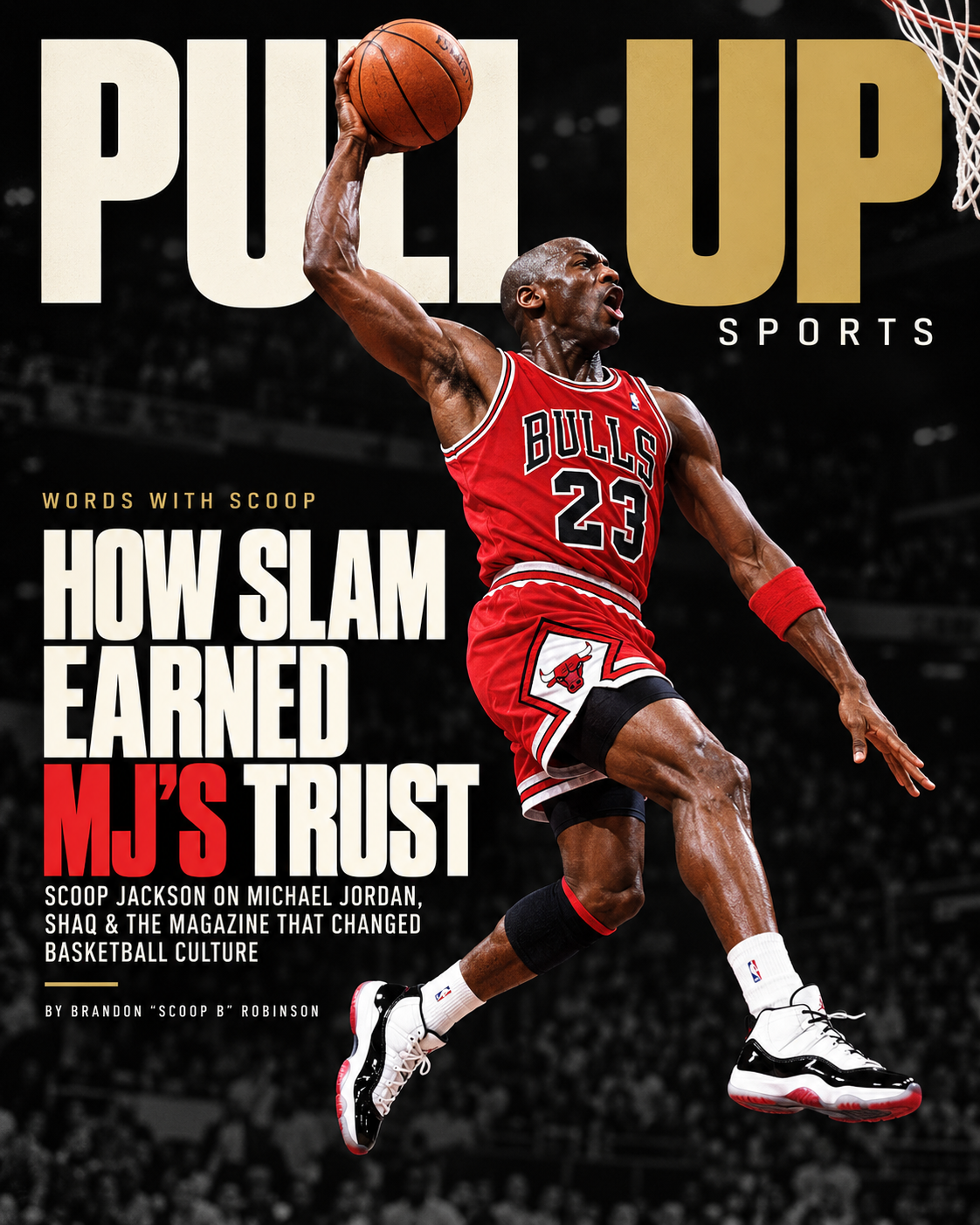
In the 1990s, SLAM Magazine emerged as the definitive voice of basketball culture, famously serving as the primary narrator for icons like Allen Iverson, Kevin Garnett, and Larry Johnson. However, when the publication first launched in 1994, it faced an existential hurdle: Michael Jordan had just stepped away from basketball to pursue baseball.
As veteran journalist Robert “Scoop” Jackson revealed in a conversation with Brandon “Scoop B” Robinson, the magazine's trajectory shifted dramatically when MJ returned to the NBA in 1995. Jackson, one of the few national writers living in Chicago with daily access to Jordan, helped forge a unique relationship between the game’s greatest player and basketball culture's boldest magazine.
Breaking Through MJ's Media Lockdown
While mainstream outlets were constantly probing and looking for friction, Jackson approached Jordan with a level of respect and restraint that was rare in the era's sports journalism landscape.
“Everyone at SLAM had a different relationship with Michael. Unlike other outlets that assigned just one writer to MJ, everybody on our team did something with him at some point,” Jackson explained. “When SLAM launched in 1994, Michael had just retired to play baseball. Publisher Dennis Page was wondering how we were going to launch a basketball magazine without Michael Jordan! But when Mike came back in 1995, I was one of the few national writers living in Chicago with daily access to him.”
Jackson’s philosophy for working with Jordan was straightforward: avoid acting like a vulture and treat him with basic human dignity.
“Michael was getting tired of mainstream media finding fault with him. My approach with Mike was simple: I never got on his nerves. I didn’t treat him like a commodity or act like a vulture. I’d talk to him without a tape recorder running—just human to human. If I had an interview question, I’d ask it and get out of his space. He respected that fairness.”
That mutual trust paid off during high-stakes playoff runs, when Jordan typically shut out the media entirely.
“During the playoffs, when MJ went into total media lockdown and stopped doing locker room scrums, he’d still look at me and say, 'Write your questions down, give them to me, and I’ll answer them on the plane ride back.' That level of access came from establishing trust and treating him with basic human dignity.”
Shaq’s Apology and the “Velvet Hammer”
The respect SLAM earned extended far beyond Chicago. Helped by Bulls PR director Tom Smithburg—who understood the magazine's cultural weight—players across the league, from Scottie Pippen to Charles Oakley, embraced the brand. Yet, winning over stars didn't always happen overnight.
When Jackson tried to secure Shaquille O'Neal for SLAM Issue #3 in the summer of 1994, Shaq initially gave him a hurried 10-minute phone interview. By the 1995 NBA Finals in Houston, however, O'Neal's perspective on the young magazine had completely changed.
“I was sitting courtside, and Shaq ran straight across the floor toward me. I thought, 'Oh man, what’s happening?' Shaq stopped and said, 'Yo, I’ve been waiting to see you. I want to apologize for how I handled that cover interview last year. That cover was dope. Whatever you need from me moving forward, let me know.'”
When other stars resisted doing interviews, SLAM editor Tony Gervino deployed a unique editorial strategy known internally as the “Velvet Hammer.” Rather than taking low blows, the staff would publish a “Protest Story”—acknowledging the player's refusal to talk while running an impeccably crafted feature that proved the magazine's standard.
More often than not, players were simply waiting for their moment to be part of the movement.
“When Rasheed Wallace refused to talk to us in Portland, I later ran into him and asked why. Sheed said, 'Man, nobody told me it was YOU writing it! They just said SLAM wanted an interview. If I knew it was you, we would’ve been good!'” Jackson recalled. “The same thing happened with Jalen Rose after the Pacers beat the 76ers in the playoffs. He ran over to me on the bench and said, 'Scoop! Now you’ve GOT to write my SLAM story!' Guys were literally waiting for their turn to be featured.”
By prioritizing authenticity over sensationalism, SLAM didn't just cover the era's biggest superstars—it became an essential rite of passage for them. From handwritten playoff Q&As on Jordan’s team plane to Shaq's courtside apology, the magazine’s relentless commitment to treating athletes like human beings earned it an unmatched level of trust. In an era dominated by corporate PR and transactional media, SLAM built a cultural movement where players didn't just tolerate the press—they actively competed to be part of the narrative.